
An IIT Chennai and Stanford University alumnus, Agarwal will assume his new role on July 1.

Dr Sangeeta N Bhatia, director, Laboratory for Multiscale Regenerative Technologies at the Massachusetts Institute of Technology, has been chosen to the newest class of the prestigious Howard Hughes Medical Institute investigators.
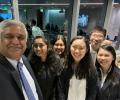
Prof Anantha Chandrakasan has been named Massachusetts Institute of Technology's new provost, the first Indian-American to serve in this leadership role.

The NAE this year has elected 69 new members and 11 foreign associates, thus bringing the total US membership to 2,250 and the number of foreign associates to 211.

Hari Balakrishnan, an Indian-origin MIT professor, has received the prestigious Marconi Prize for his fundamental discoveries in wired and wireless networking, mobile sensing, and distributed systems.

An Indian-origin PhD student at MIT, Prahlad Iyengar, has been suspended until January 2026 for his pro-Palestinian activism. The suspension effectively ends his NSF fellowship and disrupts his academic career. Iyengar is appealing the decision, arguing that it is a violation of free speech and a result of MIT's ties to the war industry. The suspension comes after MIT banned the distribution of a pro-Palestinian student-run magazine, "Written Revolution", which featured Iyengar's article "On Pacifism." The article included imagery and language that MIT deemed could be interpreted as a call for violent protest. Iyengar has been barred from campus and is facing a series of sanctions for his activism.

These are 'hidden champions' of strategic research and innovation. They are worthy of emulation within Indian industry, and maybe even a Padma!, notes R Gopalakrishnan.

Object recognition is one of the most widely studied problems in computer vision, researchers said.

Irrespective of what the future may have in store, the year 2018 has ushered humanity towards an era of next generation technology, demonstrating that there is no looking back in scientific innovations.

One should appreciate the sagacity and audacity of JRD and Nani Palkhivala in founding TCS on April 1, 1968. At that time there was no Microsoft or Intel, SAP or Accenture, much less Google.
They needed a person who could build and execute their vision: A frontiersman; a problem solver and an institution builder. It was their and India's good fortune that Faqir Chand Kohli more than measured up to their requirements and indeed laid the foundation to take TCS to unimaginable heights and to the giant success that it is today. Shivanand Kanavi salutes the incomparable F C Kohli, who passed into the ages last week.

'Running a start-up is hard.' 'We almost always will have obstacles.' 'There are two ways to tackle it.' 'We can either take them head on or let them hold you back.'
 © 2026 Rediff.com - Advertise with us - Disclaimer - Privacy Policy - Sitemap - Feedback - About us - Terms of use - Grievances